
Service · Ai enhanced imagery
AI photorealism.
Built on 3D model accuracy.
AI can produce remarkable realism. But for serious commercial imagery, products, materials, proportions and architectural details within the image need to be fully accurate.
That’s why our imagery starts with accurate 3D modelling and scene building. We then use AI to take the image further — adding the natural detail, atmosphere and photographic quality that conventional CGI can struggle to achieve.
For
Product · Interior · Architectural · Campaign imagery
built on
24 years of commercial CGI experience
APPLIED TO
Every visual asset we produce
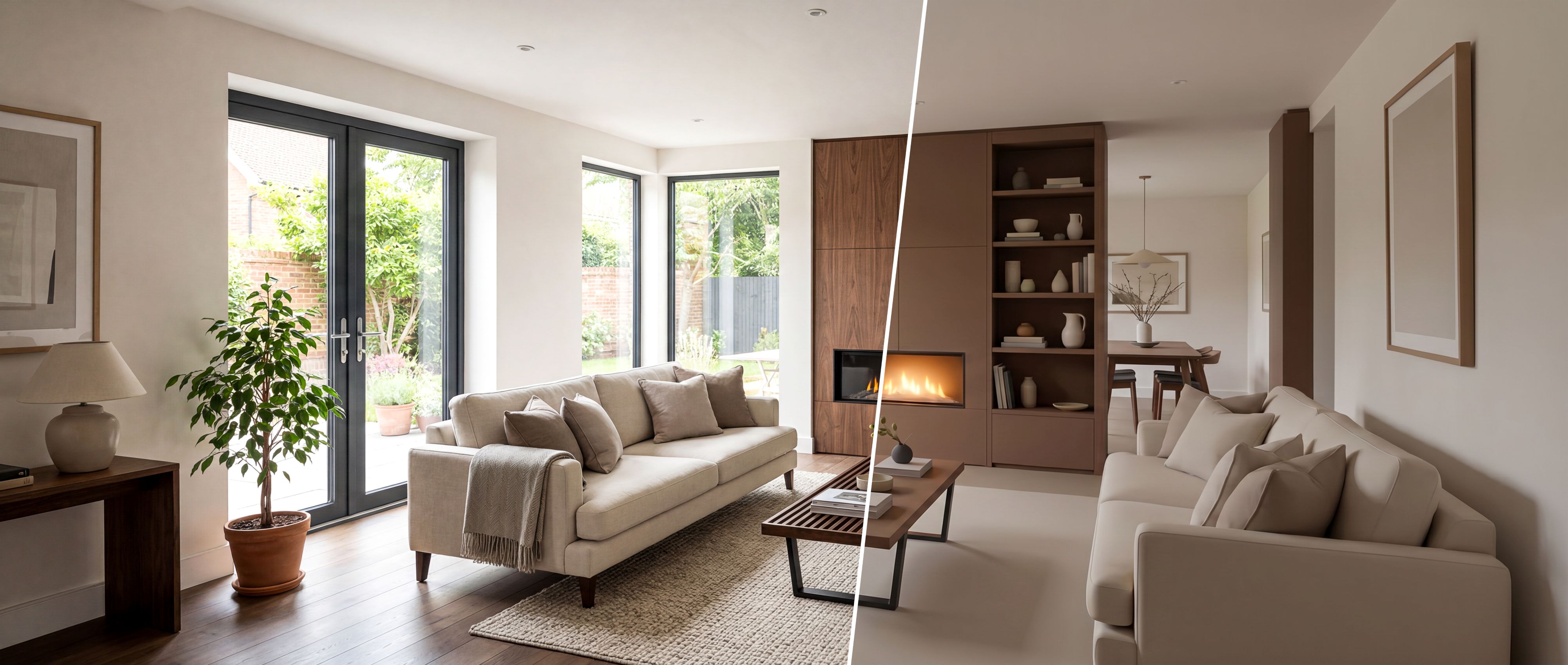
CGI render
A 3D render
Accurate. Technically correct. Doesn’t yet pass as photography.
real photograph?
With AI enhancement.
Same geometry. Same specification. Light, atmosphere, depth, and surface character — elevated.
CGI render
The image before AI.
The process starts with a controlled 3D model. Products, architecture, proportions, materials and specified details are built accurately, giving us a reliable foundation for everything that follows.
real photograph?
With AI enhancement.
AI takes that accurate foundation and pushes the image towards photography — refining light, texture, atmosphere and natural detail while retaining the design and product information established in the 3D model.
The principle
Making CGI look photographic with AI without losing the accuracy underneath.
AI enhancement is a controlled stage of our production process, not a filter or automated effect. We use it to introduce the natural material character, light, atmosphere and detail that make an image feel photographic, while the accurate 3D work underneath protects everything that needs to remain correct.
The objective is simple: remove the visual clues that tell you it is CGI without changing the product, architecture or approved design.
How the ai enhancement is calibrated
Different images need different levels of enhancement.
There is no standard AI treatment. How far we take the enhancement depends on the image, the subject and what needs to remain precisely controlled.
A product image may need only subtle improvements to materials and light. An interior can benefit from considerably more texture, atmosphere and natural detail. Architectural imagery gives us greater freedom again, particularly across landscaping, skies, people and the wider environment.
The judgement is knowing where AI can improve the image and where it should leave well alone.
image type
Product CGI stills
ENHANCEMENT USUALLY APPLIED TO
Natural material character, reflections, subtle surface texture, lighting, shadows and photographic detail.
LEFT UNTOUCHED
Product geometry, logos, text, dimensions, construction details, specified finishes, colours and other details that must accurately represent the product.
image type
Interior visualisation
ENHANCEMENT USUALLY APPLIED TO
Materials, fabrics, soft furnishings, natural light, shadows, styling detail, surface variation and the subtle imperfections found in real interiors.
LEFT UNTOUCHED
Room geometry, layouts, specified products, furniture positions and any design, material or finish that has been specifically approved.
image type
Architectural CGI
ENHANCEMENT USUALLY APPLIED TO
Landscaping, planting, skies, people, atmospheric conditions, natural light, reflections, surface character and the wider photographic environment.
LEFT UNTOUCHED
Building form, dimensions, elevations, openings, architectural details, specified materials and the approved design.
image type
3D animation frames
ENHANCEMENT USUALLY APPLIED TO
Materials, lighting, atmosphere, environmental detail and photographic characteristics across the moving sequence.
LEFT UNTOUCHED
The approved 3D geometry, products, architecture, camera movement and other elements that need to remain accurate and consistent throughout the sequence.
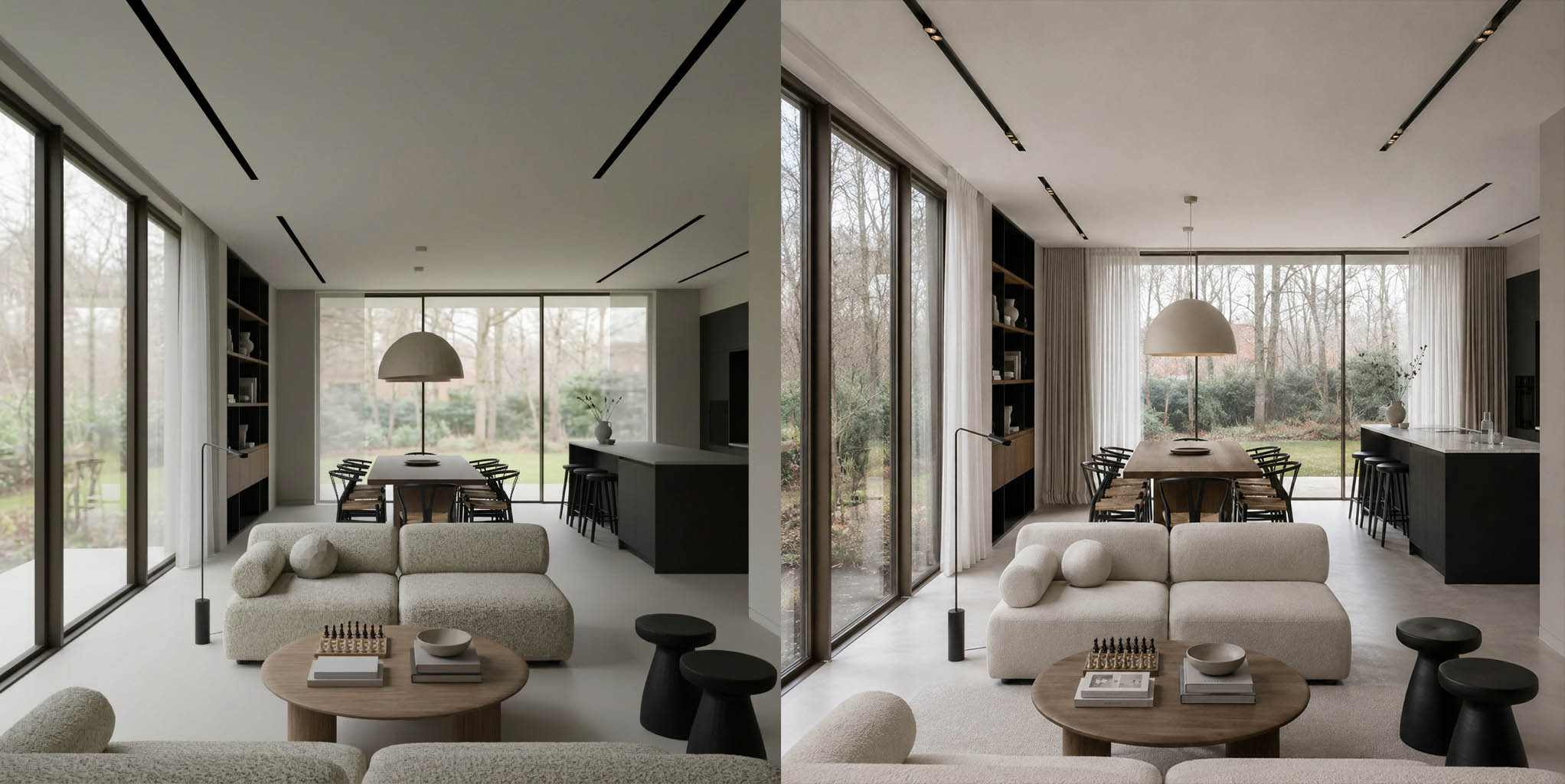
01
Turning a controlled interior visualisation into a believable space.
The accuracy of the 3D render establishes the room, layout and specified elements. AI enhancement then develops the qualities that make the finished space feel naturally photographed — from materials and lighting to the small variations and imperfections that conventional rendering can struggle to reproduce.
applied
Natural materials · Fabric detail · Lighting · Surface variation · Styling detail
preserved
Room geometry · Layout · Specified products · Approved finishes
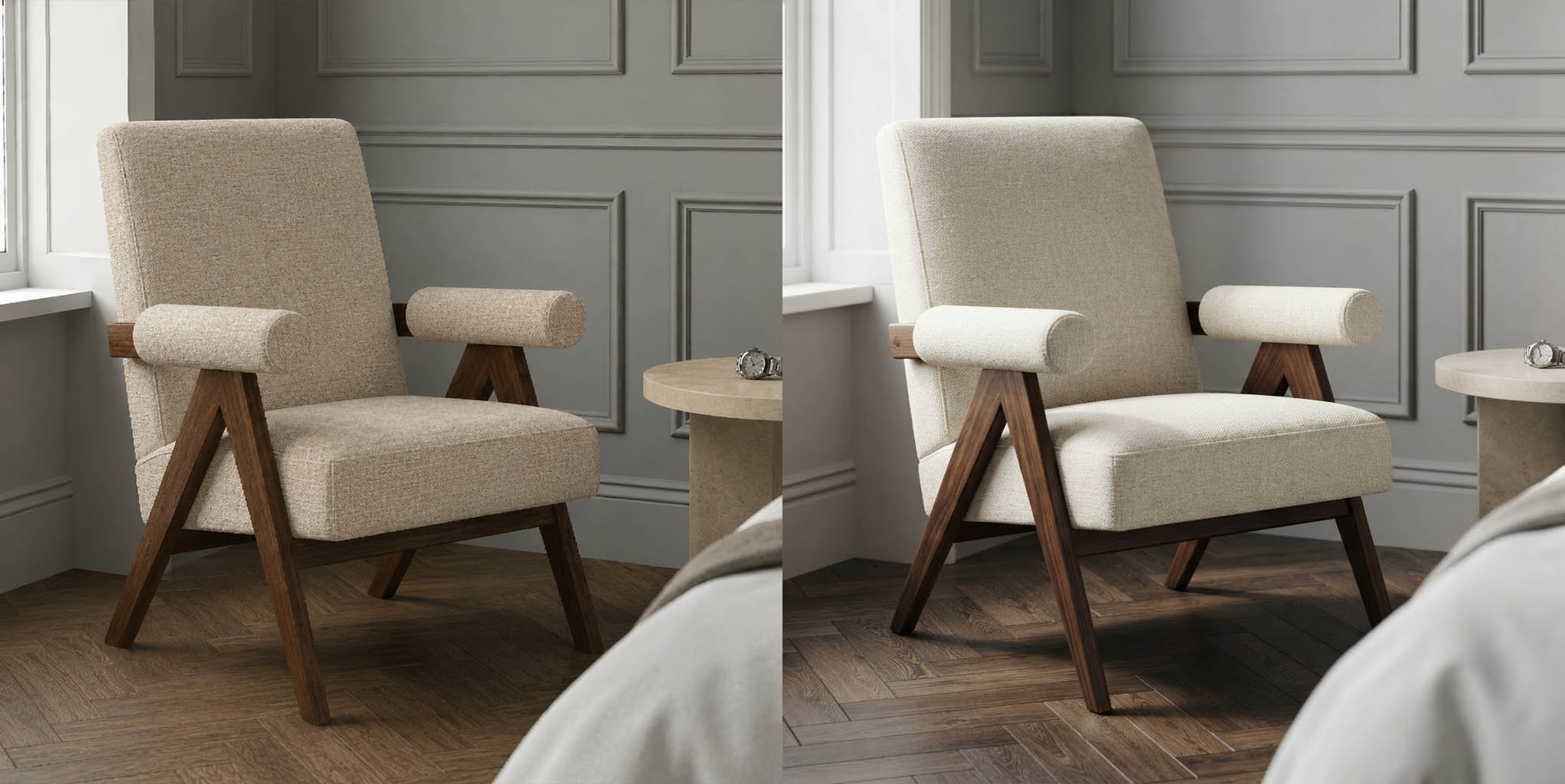
02
More realism. No compromise on the product visualisation.
With product imagery, the product itself remains the constant. The accurate 3D model controls its form, construction and specification, while AI gives us greater freedom to develop the photographic qualities of the image around it without compromising the product being represented.
applied
Material character · Reflections · Lighting · Shadows · Photographic detail
preserved
Product geometry · Construction details · Colours · Specified finishes
02
More realism. No compromise on the product visualisation.
With product imagery, the product itself remains the constant. The accurate 3D model controls its form, construction and specification, while AI gives us greater freedom to develop the photographic qualities of the image around it without compromising the product being represented.
applied
Material character · Reflections · Lighting · Shadows · Photographic detail
preserved
Product geometry · Construction details · Colours · Specified finishes
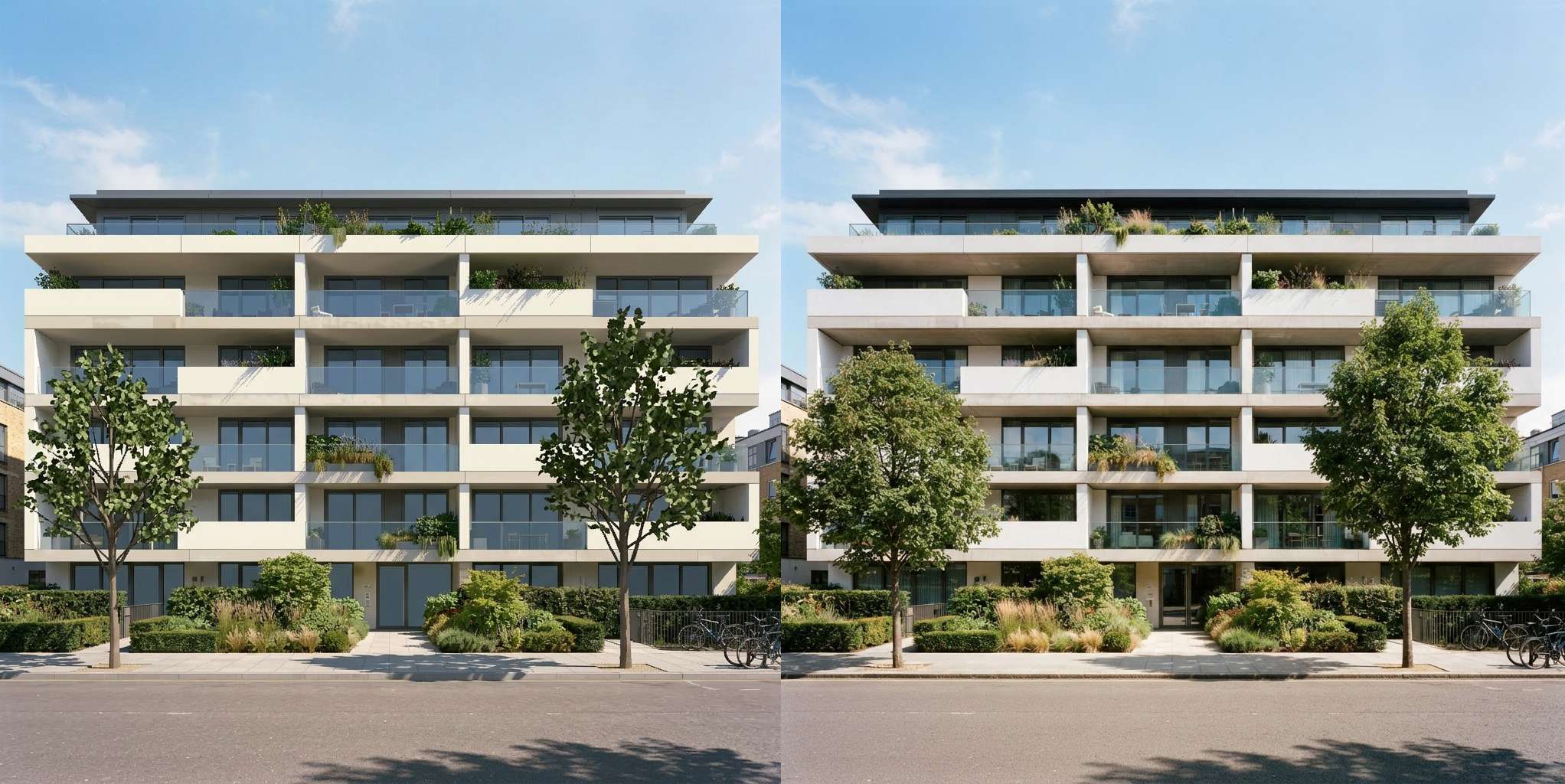
03
Accurate architecture visualisation in a more natural setting.
The architecture is established accurately in 3D before AI enhancement begins. This gives us considerably more freedom to develop everything that makes the completed scene feel real — particularly landscaping, people, natural light, atmosphere and the wider environment — while the approved building remains intact.
applied
Landscaping · People · Skies · Natural light · Atmosphere
preserved
Building form · Elevations · Openings · Architectural details · Specified materials
Worth being clear about
What our AI enhancement isn’t.
For many people, AI imagery means typing a prompt and watching an image appear. Memes, impossible scenes, concept images and increasingly sophisticated commercial visuals can all be created in seconds. The results can be remarkable, but also unpredictable, inaccurate and difficult to control.
That isn’t how we use AI.
We start with a professionally produced 3D scene, where the important details have already been designed, modelled and controlled. AI is then carefully directed to improve what is already there, adding realism, natural detail and photographic qualities without sacrificing the accuracy underneath.
It doesn’t replace the work. It takes the work further.
It isn’t one-click enhancement
There is no standard treatment applied to every render. Each image is assessed individually, with prompting, refinement and adjustment continuing until the right balance of realism and accuracy has been achieved.
What it actually is
A professionally judged process, controlled by the artist from start to finish.
It isn’t AI deciding what the image should be
We don’t hand the creative or technical decisions over to AI. The composition, product, architecture and specified details come from the approved 3D scene. AI is directed to improve the image around that controlled foundation.
What it actually is
AI working within an image we have already designed, built and controlled in accurate 3D.
It isn’t a shortcut around CGI expertise
AI can generate convincing imagery very quickly. That isn’t what we’re selling. Our process is underpinned by the modelling, lighting, materials, composition and visual judgement developed through 24 years of commercial CGI production.
What it actually is
Established CGI craft combined with a new generation of image-making tools.
Applied across every service
One approach. Many possibilities.
The same principle runs through every service we offer: start with the control and accuracy of a 3D setting, then use AI where it genuinely improves the final image. How we apply it changes with the subject. Explore each service to see what that combination makes possible.
Product CGI
Accurate 3D products, taken to a photographic finish. See how AI enhancement adds natural materials, lighting and surface character while keeping the product itself precisely controlled.
Kitchen CGI
Make a 3D kitchen look ready to photograph. See how accurate kitchen CGI and AI enhancement combine to create complete ranges, finishes and room settings without the physical set.
Bedroom CGI
Bring more softness, texture and atmosphere into 3D bedroom settings. Explore how AI enhancement helps fabrics, furnishings and materials feel naturally photographed.
Furniture CGI
Make accurate 3D furniture feel photographed, not rendered. Explore how AI enhancement brings greater depth and natural character to fabrics, woods, finishes and the interiors around them.
Bathroom CGI
Push demanding materials closer to photography. See how AI enhancement adds greater realism to tiles, ceramics, reflections, metals and light while the bathroom products remain accurate.
Windows & Doors CGI
Put an accurate 3D product into a completely believable setting. See how AI enhancement helps windows and doors sit naturally within photographic-looking properties and environments.
Architectural Visualisation
Give accurate architectural 3D buildings the natural qualities of photography. See how AI transforms the atmosphere, landscaping, people and environment around accurately visualised architecture.
Interior Visualisation
Take an accurately built 3D interior into genuinely photographic territory. See how AI develops materials, light, atmosphere and the subtle detail that makes a space feel real.
The commercial case
The quality of photography. The commercial flexibility of CGI.
Photographic realism matters because people respond more naturally to imagery they believe. Combine that realism with CGI production and the commercial possibilities change: larger image libraries become practical and cheaper, product ranges can be shown consistently across multiple settings and finishes, and imagery can continue evolving without repeated photography shoots.
AI does not replace the commercial advantages of CGI. It allows us to deliver those advantages without accepting a visibly computer-generated finish.
AUDIENCE CONNECTION
Create imagery people can connect with.
Whether you are selling a product, property, interior or experience, convincing imagery helps people imagine what it could mean to them. That emotional connection gives marketing imagery far more power than simply showing what something looks like.
build a relationship with your buyers
COMMERCIAL SCALE
Photographic quality at a volume photography struggles to match.
Once photography-level realism can be produced through CGI, considerably larger image requirements become practical. Complete ranges, multiple finishes, alternative settings and campaign libraries can be produced consistently without the cost and logistics of repeated shoots.
the best quality at scale
MORE FROM EVERY ASSET
Built for the first brief. Ready for the next.
The 3D models and approved imagery remain useful long after the first campaign. New angles, variants, settings and marketing treatments can be created as requirements change, extending the value of the original production work.
BUILT ON ASSETS THAT KEEP THEIR VALUE
From a marketing director
What AI-enhanced CGI makes possible at scale.
Common questions
Things clients ask
about the AI enhancement layer.
Six questions that come up in nearly every first conversation. If yours isn’t here, ask.
Start a project
See what happens when CGI and AI are properly combined.
From a single hero image to a complete library of marketing content, send us your brief, drawings, product information or simply tell us what you need to produce. We’ll advise on the most effective way to approach it.